 K3N8H
The Practical Entrepreneur's Workbook
A no-hype manual for making your first real dollar and building from there.
K3N8H Verified
- ✓ Real preview shipped
- ✓ License terms specified
A comprehensive manual (8 sections, ~2,600 words) covering problem-finding, first-sale mechanics, honest pricing, the bare-minimum numbers to track, and low-audience marketing, ending in a fillable 30-day action plan. States plainly there's no income guarantee.
Runs where you work
Built for a private workflow: local-first execution, no forced cloud dependency, and a clear path to use it on a laptop or phone without an API key.
Included value
Each product is designed to feel personal, useful, and complete without turning your work into an external dependency.
Free tools that go with this
These run in your browser, need no account, and keep what they remember on your own device.
Preview
Open full preview →The Practical Entrepreneur's Workbook
The Practical Entrepreneur's Workbook
A No-Hype Manual for Making Your First Real Dollar and Building From There
Table of Contents
- Why "Easy Money" Framing Fails You
- Finding a Problem Worth Solving
- Getting Your First Dollar Before Building More
- Pricing Without Guessing
- The Bare-Minimum Numbers Every Business Needs to Track
- Marketing That Doesn't Require an Audience Yet
- The Most Common Ways New Businesses Waste Their First 90 Days
- Workbook: A 30-Day Action Plan
1. Why "Easy Money" Framing Fails You
If you've spent any time looking for a way to start a business, you've seen the pitch: pick the right method, follow the steps, and money follows easily. It's a compelling pitch precisely because it's what everyone wants to be true. It also sets up almost every reader to quit at exactly the moment real businesses actually start working — the slow, unglamorous middle, where the first few sales are hard-won and nothing feels automatic yet.
This manual takes the opposite approach on purpose. Nothing here is easy in the sense of effortless. What it is: a specific, honest sequence of steps that a solo person can actually execute, in an order that gets you real signal fast instead of months into building something nobody wants.
There is no income guarantee anywhere in this document. There isn't one because nobody honest can give you one — your results depend on your market, your effort, and factors neither this manual nor anyone selling you a "system" can control.
2. Finding a Problem Worth Solving
The single highest-leverage thing you can do before starting anything is find a problem that's specific, repeated, and already costing someone something — time, money, or frustration they'd pay to make go away.
- Specific beats general. "People want to save money" is not a problem you can build a business around. "Freelancers lose track of which invoices are actually overdue" is.
- Repeated beats one-off. One person's bad day isn't a market. The same complaint from many people, in their own words, is.
- Already costing something beats hypothetical. Someone already duct-taping a workaround together (a messy spreadsheet, a manual process) is a stronger signal than someone saying "that would be nice to have."
The fastest way to find this: go to where your potential customers already complain — forums, subreddits, review sections, comment threads — and read, don't post. You're not looking for people who'd click a survey link. You're looking for people already annoyed enough to type it out unprompted.
3. Getting Your First Dollar Before Building More
The point of the first dollar isn't the money. It's proof that a stranger (or even someone in your network) valued what you made enough to actually pay, not just say something nice about it.
- Sell before you fully build. A landing page describing the exact outcome, with a real way to pay (even a simple invoice or a Gumroad link), tells you more in a week than a month of silent building.
- If nobody pays for the fully-built version, a smaller, faster, cheaper version that solves the single sharpest piece of the problem often will — and it tells you which piece actually mattered.
- Don't discount to get the first sale. A dollar someone paid at your real price is a much stronger signal than ten people who "would have paid" a discounted one.
4. Pricing Without Guessing
Most new business owners either guess low out of fear, or guess a round number that feels safe. Both skip the one question that actually determines a defensible price: what does this problem currently cost the person who has it?
- If it costs them time, price against the value of that time, not against what similar-looking products charge.
- If it costs them money already (a workaround, a worse tool, lost revenue), price as a fraction of that cost — cheap enough to be an easy yes, expensive enough to reflect real value delivered.
- Raise the price before you have to discount to make a sale. A price that's mildly too high and comes down once is far less damaging to a new business than a price that's always been too low.
5. The Bare-Minimum Numbers Every Business Needs to Track
You do not need a full accounting system on day one. You do need to know, at all times, these numbers without having to dig for them:
- Cash in the bank right now.
- What you're owed (invoiced but not yet paid) versus what you owe (bills, subscriptions, anything recurring).
- Real cost per sale — including the parts people forget: payment processing fees, your own time if you're pricing hourly work, any tool subscriptions tied directly to delivering the product.
- How many sales, this exact week — not the month, not the quarter. Weekly tracking catches a slowdown while there's still time to act on it.
A simple spreadsheet updated weekly beats a sophisticated system you update once a quarter. Consistency of a small habit beats sophistication of a system you abandon.
6. Marketing That Doesn't Require an Audience Yet
You don't need thousands of followers to get your first customers. You need a small number of specific actions repeated consistently:
- Warm outreach first. People who already know your work convert far faster than strangers — start there, not with cold ads.
- Answer the actual question, publicly, once a week. Take the most common question from real conversations (not a guess at what people want to know) and answer it as a piece of content. This produces sharper content than generic advice, because it's answering something someone already asked.
- Ask for one specific referral per happy customer, not a vague "let people know." "Do you know one person dealing with [specific problem]?" produces real names. "Spread the word" produces silence.
7. The Most Common Ways New Businesses Waste Their First 90 Days
...
Preview truncated — full file included after purchase.
Preview truncated — full file included after purchase.
What's included
- manuscript.md (8 sections + 30-day workbook)
- cover.png
- README.md
Built with
Written guide in Markdown
License & pricing
Try it before you buy. The preview above is the real product, not a mockup.
Personal License
$13
For your own work or your own business. No client work, and no resale or redistribution of the files.
Refund terms are set per product, and checkout through Whop or Gumroad has its own buyer protection. Questions before you buy? Ask in the chat or on the feedback page; we'll help where we can.
Books — publishing standard
- Required deliverables: Formatted PDF/EPUB, Cover, Table of contents
Original writing only. Cite real sources; no fabricated data or studies.
More from Entrepreneurs & Small Business

The First Dollar Checklist
A short, tactical guide to getting your very first paying customer.
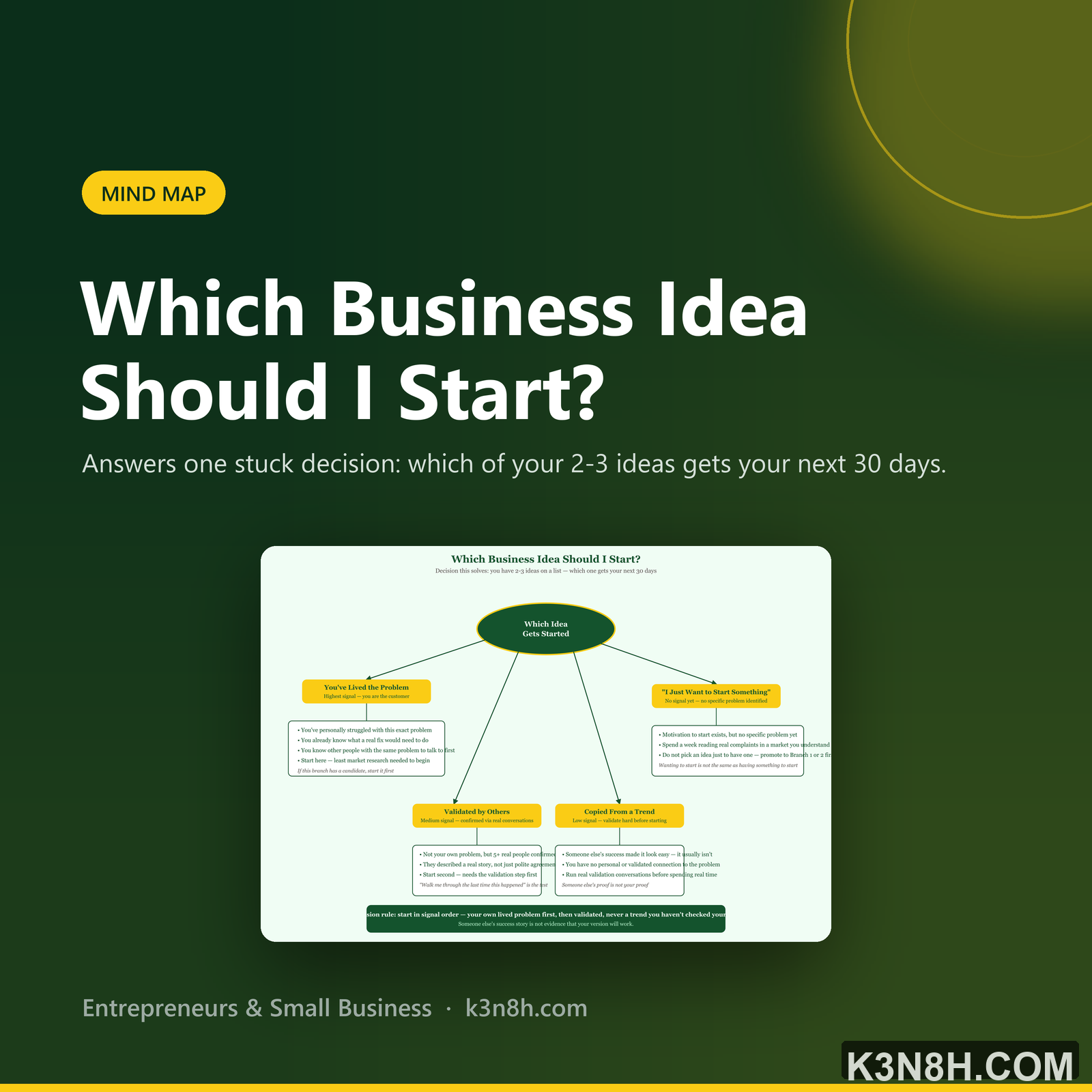
Which Business Idea Should I Start?
Answers one stuck decision: which of your 2-3 ideas gets your next 30 days.
Idea to First Customer
A general-purpose business plan for a first-time solo founder — adapts to almost any small business.