 K3N8H
Idea to First Customer
A general-purpose business plan for a first-time solo founder — adapts to almost any small business.
K3N8H Verified
- ✓ Real preview shipped
- ✓ License terms specified
- ✓ Stated limitations verified
A niche-agnostic business plan template: summary, market, model, go-to-market, financials, and risks, built for taking one validated idea to a first paying customer.
Runs where you work
Built for a private workflow: local-first execution, no forced cloud dependency, and a clear path to use it on a laptop or phone without an API key.
Included value
Each product is designed to feel personal, useful, and complete without turning your work into an external dependency.
Free tools that go with this
These run in your browser, need no account, and keep what they remember on your own device.
Preview
Open full preview →Idea to First Customer
Business Plan: Idea to First Customer
A general-purpose template for a first-time solo founder taking one validated idea to a first paying customer — not niche-specific by design, so it's adaptable to almost any small service or product business.
Disclaimer: This document is for informational purposes only and does not constitute financial, legal, or investment advice. All figures below are illustrative example numbers for a hypothetical solo service business and must be replaced with your own real numbers before you rely on them.
1. Executive Summary
[Founder Name] is launching [Business Name], a [one-sentence description of what you sell and to whom], validated through direct conversations before building (see the companion "Which Business Idea Should I Start?" mind map and Practical Entrepreneur's Workbook for the validation method). Target: first paying customer within 30 days, 10 paying customers by month 6.
Worked example figures used throughout: $75 average sale, 10 customers/month by month 6, $0 paid advertising in the first 90 days.
2. Market Analysis
- Target customer: [describe specifically — not "everyone who needs X"].
- Evidence base: [X] real conversations confirming the problem, using the "walk me through the last time this happened" method rather than a hypothetical survey question.
- Competitive landscape: [list 2-3 real alternatives your target customer currently uses, including doing nothing/a manual workaround — "doing nothing" is often the real competitor for a new small business].
3. Business Model
- Revenue: [one-time sale / recurring subscription / hourly service — pick one to start; adding a second revenue model before the first is proven usually slows you down, not speeds you up].
- Cost structure (example, monthly): basic tools/software $50, payment processing (~3% of revenue), any direct materials/subcontractor cost per sale — keep fixed costs minimal until revenue is proven.
- Unit economics (example): at a $75 average sale and ~$15 direct cost per sale, gross margin is roughly $60/sale before your own time — track this explicitly, don't assume it holds as you scale.
4. Go-to-Market Plan
| Phase | Timeframe | Focus |
|---|---|---|
| Phase 1 | Days 1-7 | Warm outreach to people who already know your work (see the companion First Dollar Checklist) |
| Phase 2 | Days 8-30 | Convert first conversations into paying customers; ask every buyer why they said yes |
| Phase 3 | Months 2-3 | Add one weekly piece of content answering a real customer question, not generic advice |
| Phase 4 | Months 4-6 | Ask every customer for one specific referral; track which channel actually produces customers |
Assumption: your warm network is large enough to produce the first 5-10 customers without paid acquisition. If it isn't, Phase 1 will surface that early, when it's cheap to know.
5. Financial Projections (Example — First 6 Months)
| Month | Customers | Revenue (example) | Notes |
|---|---|---|---|
| 1 | 2 | $150 | Warm-network phase |
| 2 | 4 | $300 | First referrals starting |
| 3 | 6 | $450 | Content + referrals compounding |
| 4 | 8 | $600 | |
| 5 | 9 | $675 | |
| 6 | 10 | $750 | Approaching the plan's 6-month target |
Figures assume the go-to-market phases above execute on schedule. Real results depend heavily on your specific market and offer, and can vary significantly from this example.
6. Risks
- Overestimating warm-network size: if Phase 1 produces fewer conversations than expected, that's real signal to address early, not a reason to push through with the same approach for months.
- Underpricing out of founder nerves: re-check Section 3's unit economics against your real costs before discounting to win a sale.
- Building before validating: if you haven't run real "walk me through the last time" conversations, this whole plan rests on an unconfirmed assumption — do that first.
- Single-channel dependency: relying entirely on one referral source means losing it stalls growth. Diversify by month 4 if one channel is carrying the whole pipeline.
7. How to Use This Template
- Replace every bracketed placeholder and example figure with your own real numbers.
- Re-run Section 5 with real data after 30 days.
- Revisit Section 6 monthly — risk profile shifts fast in a new business's first two quarters.
Preview truncated — full file included after purchase.
What's included
- business-plan.md (editable)
- README.md
Built with
Written guide in Markdown
License & pricing
Try it before you buy. The preview above is the real product, not a mockup.
Single-Founder License
$16
For your own use on a single project. No resale or redistribution.
Advisor/Incubator License
$40
Use across client work or resell the output. No reselling the source files/template itself.
Refund terms are set per product, and checkout through Whop or Gumroad has its own buyer protection. Questions before you buy? Ask in the chat or on the feedback page; we'll help where we can.
Business Plans — publishing standard
- Required deliverables: Editable file, Filled example, Stated assumptions, Risk section, Disclaimer
- Disclaimer required
- Personal vs. commercial license tiers offered
Niche-specific: summary, market, model, go-to-market, financials with stated assumptions, risks.
More from Entrepreneurs & Small Business

The First Dollar Checklist
A short, tactical guide to getting your very first paying customer.
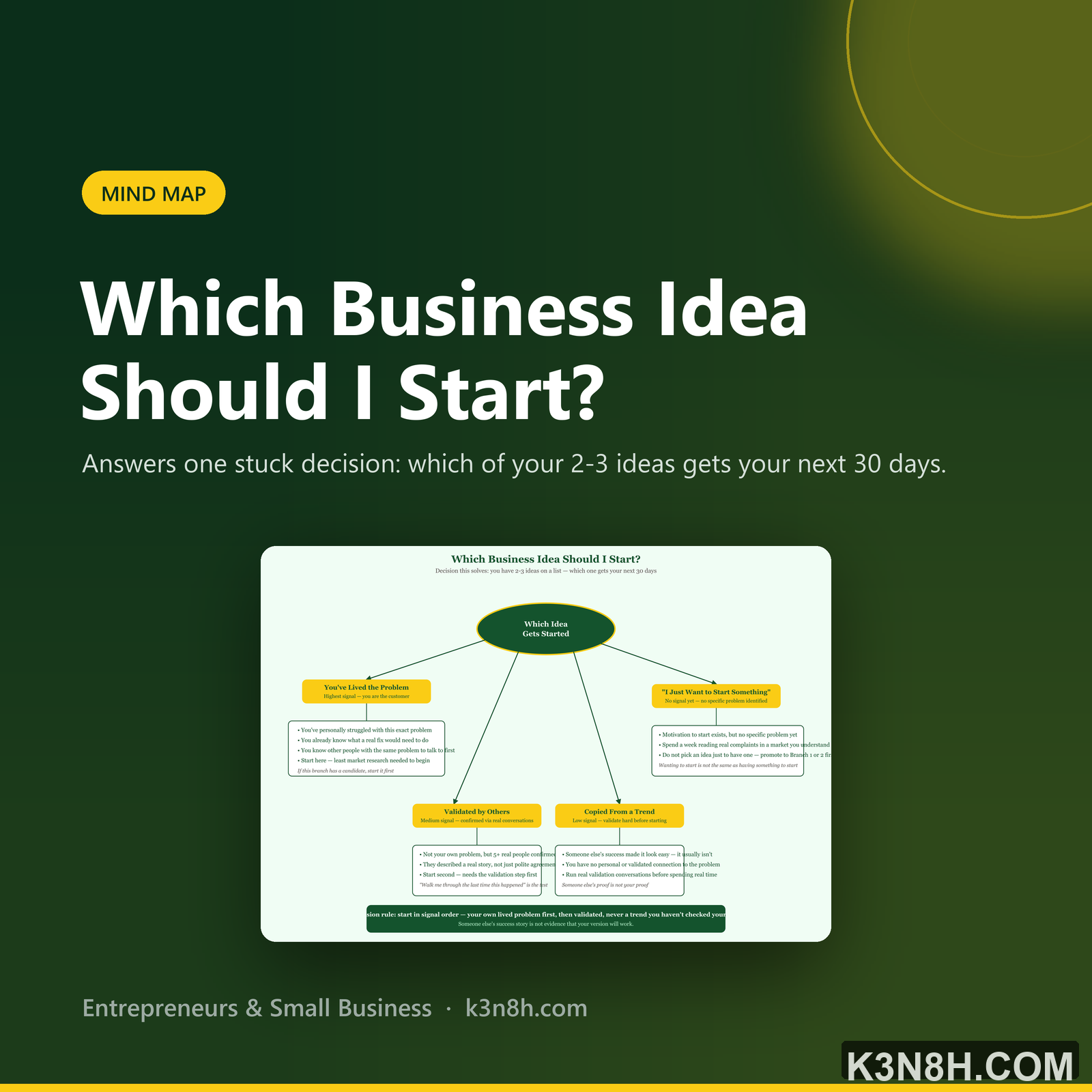
Which Business Idea Should I Start?
Answers one stuck decision: which of your 2-3 ideas gets your next 30 days.
The Practical Entrepreneur's Workbook
A no-hype manual for making your first real dollar and building from there.