 K3N8H
The Discovery Call Playbook
A 5-block script for discovery calls, from open to close — full worked example included.
K3N8H Verified
- ✓ Real preview shipped
- ✓ License terms specified
- ✓ Stated limitations verified
An operational script for a coaching/consulting discovery call: open, qualify, diagnose, pitch, close — with explicit decision points at each stage and a complete filled worked example following one real call with a prospective client.
Runs where you work
Built for a private workflow: local-first execution, no forced cloud dependency, and a clear path to use it on a laptop or phone without an API key.
Included value
Each product is designed to feel personal, useful, and complete without turning your work into an external dependency.
Free tools that go with this
These run in your browser, need no account, and keep what they remember on your own device.
Preview
Open full preview →The Discovery Call Playbook
The Discovery Call Playbook
An operational script for a coaching/consulting discovery call, from open to close
Disclaimer: This document is for informational purposes only and does not replace professional, legal, tax, or licensing advice specific to your situation. Any worked example is illustrative and must be verified against your own numbers.
How to use this playbook
Work through the 5 blocks in order on every discovery call. Each block has a decision point — what you do next depends on the prospect's actual answer, not a fixed script you read verbatim. The filled example follows one real call structure with a prospective 1:1 coaching client, "Dana."
Block 1: Open (2 minutes)
Decision point: is this prospect here to explore, or did they already half-decide and just need confirmation? Their opening answer tells you which mode to run the rest of the call in.
Script shape: "Thanks for booking time — before I ask anything, what made you reach out right now?"
Filled example: Dana says "I've been putting this off for six months and finally just did it." → Signal: already decided in principle, run the call in confirm-and-scope mode rather than heavy persuasion mode.
Block 2: Qualify (5 minutes)
Decisions to make:
- Do they have the authority/budget to actually hire you, or do they need to check with someone else first?
- Is the problem they describe one you've actually solved before, or would this be a stretch case?
Script shape: "What have you already tried for this?" then "What would need to be true for you to say yes to working together, if this call goes well?"
Filled example: Dana tried a group program before and felt it was "too generic." Budget is hers alone to decide. → Qualifies: real problem in your wheelhouse, real authority to buy.
Block 3: Diagnose (10 minutes)
Decision point: are you hearing a surface complaint or the real root cause? Ask "why" at least twice before treating any stated problem as the real one.
Script shape: "You mentioned X — what's that actually costing you day to day?" then "If X had been solved a year ago, what would be different right now?"
Filled example: Dana's surface complaint was "I procrastinate on outreach." Second "why" revealed the real issue: she has no system for choosing which prospects to pursue, so every outreach session starts with decision fatigue before any actual work happens.
Block 4: Pitch (5 minutes)
Decisions to make:
- Pitch the specific mechanism that addresses the diagnosed root cause, not your generic program description.
- State price once, clearly, without immediately discounting or hedging.
Script shape: "Based on what you just told me, here's specifically what I'd have us do first: [mechanism tied to their diagnosis]. The program is $X for Y months."
Filled example: "Since the real issue is no prospect-selection system, week one is building your qualification criteria before any outreach scripts. The program is $2,400 for 3 months."
Block 5: Handle Objections and Close
Decision point: is the objection about money, time, or trust? Each needs a different response — don't default to a discount for every objection type.
Script shape for a trust objection: "What would you need to see to feel confident this works for your specific situation?" (then address that specific thing, don't just repeat your pitch louder)
Filled example: Dana's objection was timing, not money or trust ("can I start next month instead?"). Response: offered to hold her spot with a deposit rather than discounting or dropping the price to close faster.
What this playbook does not do
- It doesn't guarantee a close — it's a decision structure for the conversation, not a persuasion trick that overrides a genuine no.
- It doesn't replace listening — every "filled example" branch depends on what the prospect actually says, not a fixed script read verbatim.
Preview truncated — full file included after purchase.
What's included
- playbook.md (editable)
- Filled worked example
- Explicit decision points
- Disclaimer
- README.md
Built with
Written guide in Markdown
License & pricing
Try it before you buy. The preview above is the real product, not a mockup.
Personal License
$11
For your own work or your own business. No client work, and no resale or redistribution of the files.
Commercial License
$31
Use across client work or resell the output. No reselling the source files/template itself.
Refund terms are set per product, and checkout through Whop or Gumroad has its own buyer protection. Questions before you buy? Ask in the chat or on the feedback page; we'll help where we can.
Product Playbooks — publishing standard
- Required deliverables: Editable file, Filled worked example, Explicit decision points, not just narrative, Disclaimer
- Disclaimer required
- Personal vs. commercial license tiers offered
A step-by-step operational execution guide (what to decide and when), distinct from a Business Plan's market/financials structure.
More from Coaches & Consultants

The 5-Client Month
A week-by-week plan to book 5 new clients from your warm network — no ad spend.
Session Notes Summarizer
Raw session notes in, structured summary with action items out — one command.
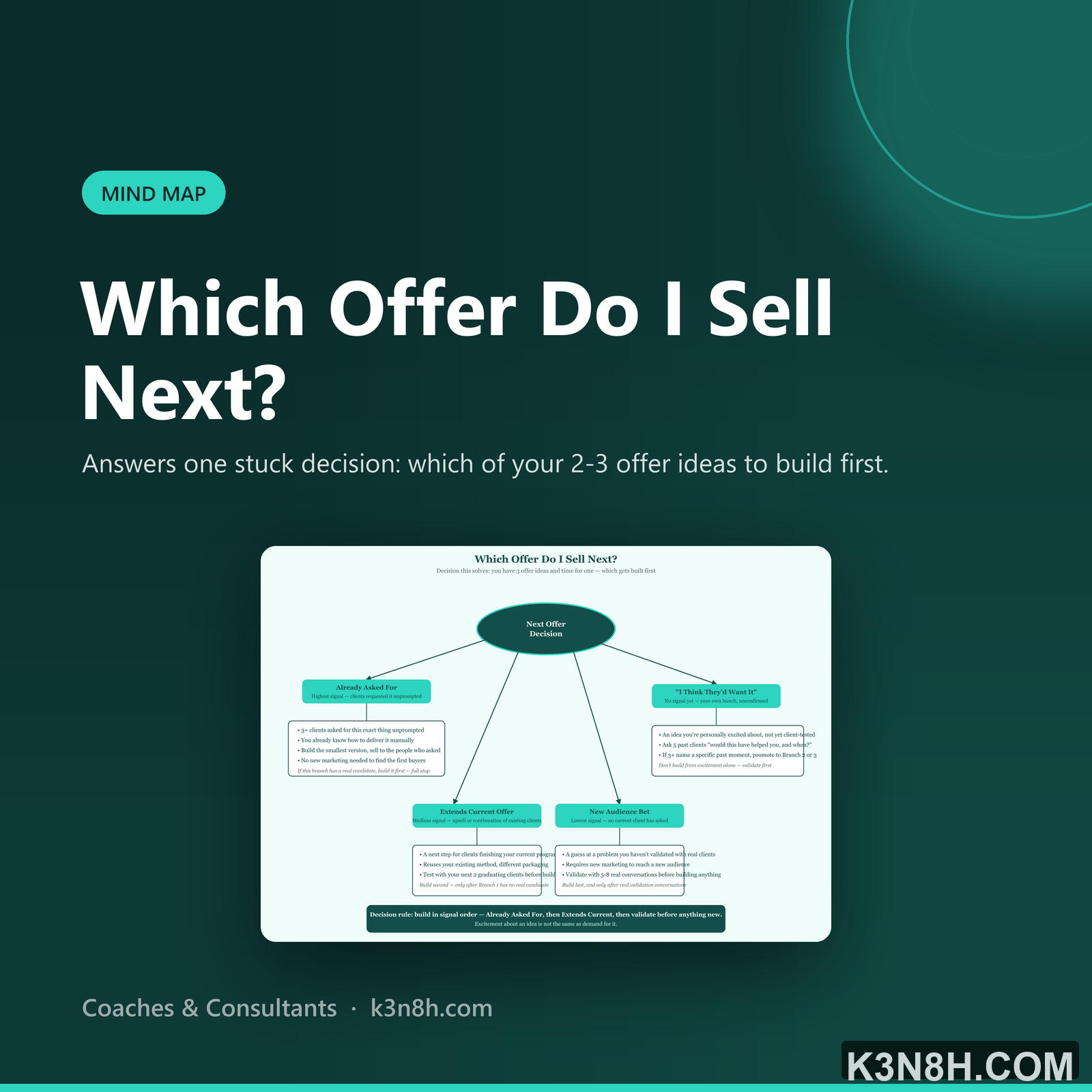
Which Offer Do I Sell Next?
Answers one stuck decision: which of your 2-3 offer ideas to build first.