 K3N8H
K3N8HBusiness Plan Template for Contractors: What Should It Include?
Why a generic business plan template fails a contractor
Open a generic business-plan template and try to fill in the "operations" section for a contracting business. It'll ask about your supply chain and your organizational chart in the abstract language of a business school case study, and never once ask about crew size, job margin after callbacks, or what happens to cash flow if a big job's payment is thirty days late. Those are the questions that actually determine whether a contracting business survives its first year, and a template that never mentions crews, jobs, or draws will leave exactly the parts that matter blank while you fill in generic sections that don't tell you anything you didn't already know.
What a contractor plan needs that a generic one skips
Crew size and real cost. Not a headcount — the actual loaded cost of each person on a crew, including the hours that don't get billed to a specific job (drive time, waiting on materials, callbacks). A plan that only counts billable hours against crew cost will look more profitable than the business actually is.
Typical job margin after callbacks, not before. A margin number calculated only from the original invoice, with no allowance for the callback and warranty hours that come later, overstates what the business actually earns per job. The plan should state a margin range that already has that adjustment built in, based on real job history, not the number a client sees at the point of sale.
The first 90 days of work you can actually line up, not a hopeful revenue projection. This is the section most generic templates get most wrong — they ask for a 12-month or 3-year revenue forecast built from a growth-rate assumption, when what a new or growing contracting operation actually needs is a specific, checkable list: which jobs are already lined up, which leads are real enough to plan around, and what the cash position looks like at day 30, 60, and 90 of actually running that work.
What happens if a big job's payment is late. Because contractor cash flow problems are almost always a timing issue rather than a profitability one, the plan should explicitly model what a two- or four-week payment delay on the largest job in the pipeline does to the ability to make payroll or buy materials for the next job. If the plan doesn't survive that scenario on paper, it's better to find out while it's still a hypothetical.
Where to build this from
The Solo Operator's First 90 Days is built around exactly this shape rather than a generic launch plan: three 30-day blocks, each with real decisions and a cash checkpoint, following a consistent example throughout so you can see how the numbers connect from one 30-day block to the next rather than restarting the logic each time. Using it as the backbone of a contractor business plan means the first-90-days section isn't a blank projection — it's a structure with a real cash checkpoint already built into it that you adapt to your own crew and market.
For the margin-after-callbacks number, Job Cost Insights is the tool that actually produces it: feed it a job-cost CSV (quoted amount, materials, labor hours and rate, permit cost) from real completed jobs, and it computes per-job margin and a sorted chart, giving you a real, evidenced number to put in the plan instead of an estimate. And if the plan covers more than one crew, the Crew Dispatch Board — three linked tables for technicians, jobs, and assignments — is worth referencing directly in the operations section, since "how work actually gets assigned so nothing falls through a group text" is a real operational detail a generic plan never addresses.
Licensing, insurance, and other fixed costs the plan can't skip
A generic business plan treats overhead as a single line item; a contractor plan needs to itemize the specific fixed costs that come with the trade — liability insurance, any required bonding, license renewal fees, vehicle and tool costs, and workers' comp if you have even one employee. These costs don't scale down for a slow month the way materials costs do, which means they're the numbers most likely to blindside a new contracting business in its first winter or its first slow season. Listing them explicitly, with real dollar figures rather than a rounded estimate, forces the plan to answer a question a generic template never asks: what's the minimum number of jobs per month needed just to cover the costs of being allowed to legally do this work, before a single dollar goes toward profit or your own pay.
The test for a finished plan
A contractor business plan is complete when a crew size and cost, a margin range that already accounts for callbacks, a specific 90-day work list, and a late-payment scenario are all filled in with real numbers from your own jobs — not projections borrowed from a template's example business. If any of those four sections is still generic, that's the section to go back and rebuild before the plan is worth relying on.
Related products
The Solo Operator's First 90 Days
Three 30-day blocks, each with real decisions and a cash checkpoint.
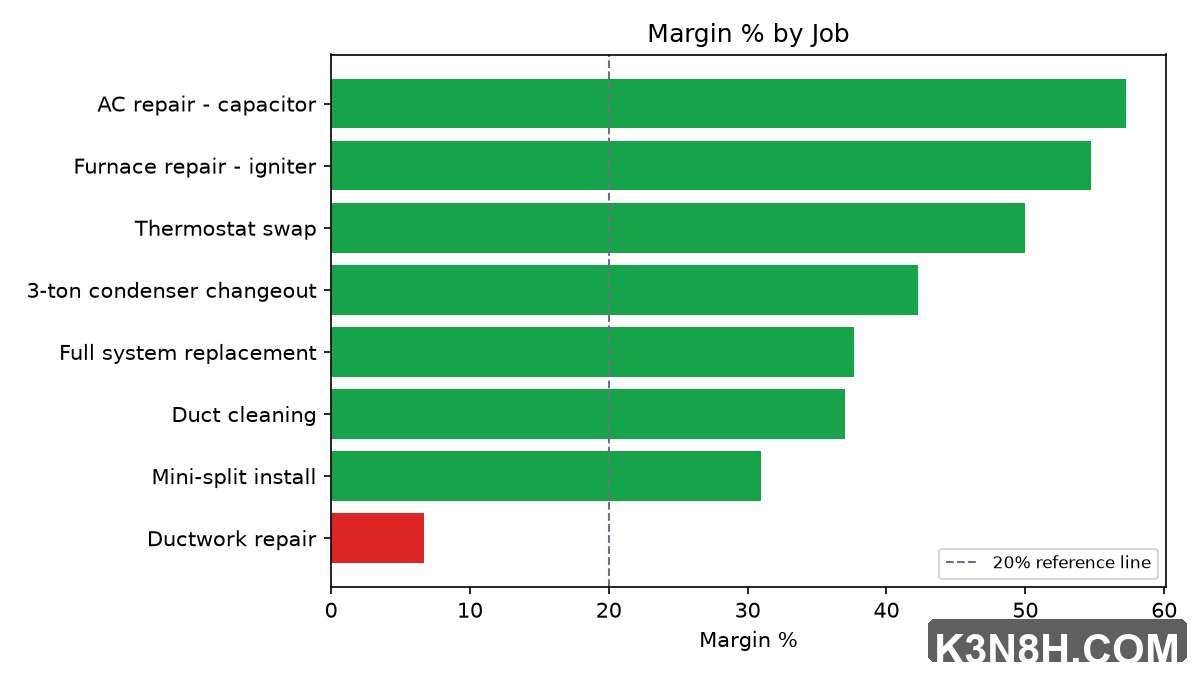
Job Cost Insights
Feed it a job-cost CSV, get a margin chart and a plain-English write-up.