 K3N8H
K3N8HHow to Track Job Costs as a Contractor
Why job costing fails when it isn't done in real time
Ask most solo contractors what their margin was on last month's jobs and you'll get a shrug or a number that's really just revenue minus a rough guess at expenses. That's not a margin — it's a wish. Job costing only works if it happens close to when the cost occurs: materials, labor hours, and callback time logged against the specific job that generated them, not lumped into one monthly total you try to reconstruct later from memory, receipts in a truck console, and a text thread with your supplier.
The reason real-time logging matters so much is that costs and revenue arrive on completely different schedules. Materials get paid for on Tuesday. The invoice gets paid three weeks later, if it's on time. If you're not tying the Tuesday cost to the specific job it belongs to the moment it happens, by the time the invoice clears you'll have long since forgotten which materials receipt went with which callback, and the number you eventually get will be an average across jobs, not a real answer for any one of them.
What "close to the cost" actually means day to day
It doesn't mean building a full accounting system. It means, for each job, keeping four numbers current as the job happens: the quoted price, materials cost so far, labor hours logged at a real rate (not a guessed one), and any subcontractor spend. That's a small enough list to update from a truck at the end of a day, and it's enough to answer the only question that actually matters — did this job make money.
Turning raw job costs into a decision
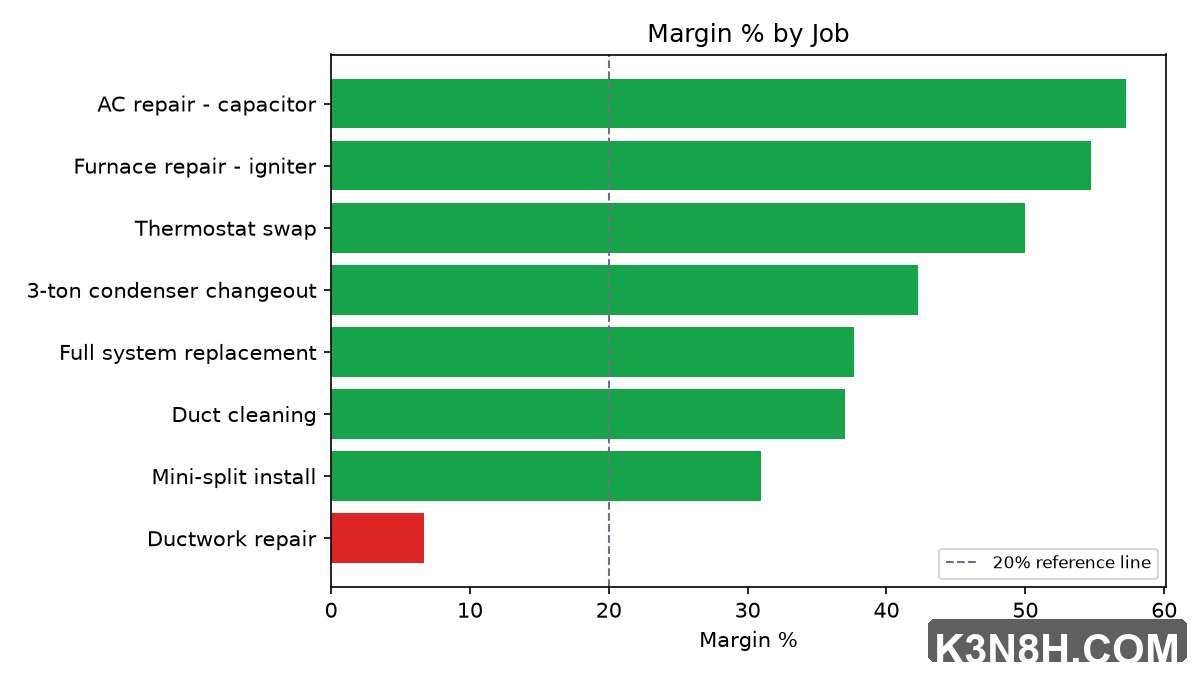
Once the raw numbers exist, Job Cost Insights does the part that's tedious to do by hand across more than a couple of jobs: feed it a job-cost CSV export — quoted amount, materials, labor hours and rate, permit cost — and it cleans the data, computes per-job margin, and produces a sorted margin chart along with a written summary of which jobs are actually profitable. The output isn't a guess dressed up as a chart; it's generated by actually running the numbers you gave it, which means the sorted list at the top is a real ranking of your best and worst jobs this period, not an impression.
Seeing that ranking tends to be uncomfortable the first time, because it usually surfaces at least one job type that "feels" profitable — steady work, a good client, no drama — but actually runs a thin margin once materials and labor are counted honestly. That's the entire point: job costing exists to correct the gap between how a job felt and what it actually earned.
The line contractors always skip: callbacks
The single most-skipped cost in a contractor's own tracking is the hours spent going back to fix something after a job is marked "done." A callback doesn't show up on the original invoice, so it's easy to treat it as a one-off annoyance instead of a real cost against that job's margin — but the hours are real, and if you don't log them against the original job, your margin number for that job is quietly wrong, sometimes wrong enough to flip a job from profitable to a loss. The Warranty Callback Tracker keeps completed jobs and reported callbacks in two linked tables and cross-references them with real calendar-month math to determine whether a callback falls inside the job's warranty window, so the callback time gets attributed to the job it actually belongs to instead of disappearing into "general overhead."
Putting it together across a week
A workable weekly rhythm looks like this: log materials and labor against the job as the week happens, note any callback against the original job the moment it comes in, and once a week — or once a month, at minimum — run the accumulated CSV through Job Cost Insights to see the sorted margin ranking. If a job's margin surprises you, check whether it's a one-off (a bad quote, an unusual material price spike) or a pattern across every job of that type — because a pattern means your pricing for that kind of job needs to change, not just this one instance of it.
Job costing that happens weekly, tied to real numbers per job, is what turns "I think we did okay this month" into "these three job types are worth taking, and these two aren't" — which is the actual decision job costing exists to support.
Connecting job costs to the cash you actually have
Job costing tells you whether a job was profitable. It doesn't by itself tell you whether you had the cash on hand to survive doing it — those are related questions but not the same one, and a solo operator needs both answered. The Weekly Cash Desk covers the second half: enter opening cash, a cash floor, tax set-aside percentage, weekly draw, overhead, and expected receipts and spend, and it prints a 13-week forecast stamped CAN BOOK, HOLD SPEND, or FILL THE BOOK for each week. Running job costing and a cash forecast side by side answers a question neither one answers alone — not just "was this job profitable," but "could we actually afford to take it when it came in."
Why this matters more for a solo operator than a bigger shop
A larger contracting company has an office manager or a bookkeeper whose job includes catching a mispriced job before it becomes a pattern. A solo 1099 operator doesn't have that second set of eyes, which means the only check on whether your pricing is actually working is whether you go looking for it yourself, on a schedule, rather than noticing it eighteen months later when the bank account is thinner than it should be. Treat the weekly or monthly job-cost review as that missing second set of eyes — a deliberate five-minute habit that replaces a role you don't have anyone else to fill.
What to do when a job type consistently loses money
If Job Cost Insights shows the same category of job landing at the bottom of the margin ranking more than once, the fix is rarely to work faster on that job type — it's almost always to requote it. Either the original price for that kind of work was set too low relative to its real materials and labor cost, or the callback rate on that job type is high enough that it needs a different warranty structure or a different price to absorb it. Job costing only pays off if the number it produces actually changes your next quote — otherwise it's just a more accurate record of the same mistake repeating.