 K3N8H
Real Estate Team Business Plan
Launching a 3-agent team: summary, market, model, GTM, financials, risks — filled example included.
K3N8H Verified
- ✓ Real preview shipped
- ✓ License terms specified
- ✓ Stated limitations verified
A niche-specific business plan for launching a real estate team inside a brokerage, with every financial figure marked as an example assumption to replace with your own market data.
Runs where you work
Built for a private workflow: local-first execution, no forced cloud dependency, and a clear path to use it on a laptop or phone without an API key.
Included value
Each product is designed to feel personal, useful, and complete without turning your work into an external dependency.
Free tools that go with this
These run in your browser, need no account, and keep what they remember on your own device.
Preview
Open full preview →Real Estate Team Business Plan
Business Plan: Launching a 3-Agent Real Estate Team Within a Brokerage
Editable template with a fully filled worked example. Replace the bracketed and example figures with your own market data before using this for financing, recruiting, or planning decisions.
Disclaimer: This document is for informational purposes only and does not constitute financial, legal, or investment advice. All market data, assumptions, and financial projections below are illustrative example figures for a hypothetical mid-size US suburban market and must be independently verified against your actual local MLS data, brokerage split, and cost structure before you rely on them.
1. Executive Summary
[Agent Name] is forming a 3-person real estate team — 1 team lead (licensed 6+ years) and 2 buyer's agents — operating under [Brokerage Name] in [Market Area]. The team targets closing 48 transaction sides in Year 1, growing to 84 by Year 3, by combining the lead's existing sphere-of-influence pipeline with paid lead generation and a structured buyer's-agent conversion process.
Worked example figures used throughout this plan: average sale price $410,000; average commission rate 2.5% per side; team split to brokerage 20%; team lead keeps 100% of sides they personally source, buyer's agents keep 60% of sides they close (team keeps 40% to cover lead cost + operations).
2. Market Analysis
- Target market: [Market Area] — suburban, single-family dominant, median home price $410,000 (example figure — replace with your MLS's current median).
- Market size (example): ~1,200 residential transactions/year in the target zip codes, per [example: last 12 months of MLS closed data].
- Competitive landscape: 6 established teams and ~140 solo agents in the same MLS area. Differentiation: faster buyer response time (committing to <10 minute lead response, tracked) and a dedicated listing-marketing package (see the companion Listing Description Bot and content-strategy mind map products).
- Assumption: Lead-to-appointment conversion of 18%, appointment-to-signed- buyer-agreement of 55%, signed-buyer-to-closed-transaction of 40%. (These are illustrative benchmarks — replace with your own CRM's historical numbers once you have 90 days of data; industry-wide benchmarks vary widely by market.)
3. Business Model
- Revenue: Commission income only. No flat-fee or referral-fee revenue modeled in Year 1.
- Cost structure (example, monthly):
- Brokerage desk/technology fee: $250/agent
- CRM + dialer software: $400 total
- Paid lead generation (Zillow Flex / Google LSA, illustrative): $3,500
- Marketing (signage, photography, listing bot/content tools): $600
- Team lead's admin/ISA (part-time, Month 4+): $1,800/mo
- Unit economics (example): at $410,000 average price and 2.5% side commission ($10,250 gross per side), after 20% brokerage split and buyer's-agent 60% payout, the team nets roughly $3,280 per buyer's-agent-sourced side before fixed costs.
4. Go-to-Market Plan
| Phase | Timeframe | Focus |
|---|---|---|
| Phase 1 | Months 1–2 | Recruit 2 buyer's agents; set up CRM, lead routing, and the <10-min response SLA |
| Phase 2 | Months 2–4 | Launch paid lead gen (start at $2,000/mo, scale to $3,500/mo once cost-per-appointment is known) |
| Phase 3 | Months 4–6 | Add part-time ISA to handle lead qualification; team lead shifts to listings + coaching |
| Phase 4 | Months 6–12 | Layer in past-client/sphere referral program (see companion CRM system for the pipeline tracker) |
Assumption: it takes 60–90 days for a newly hired buyer's agent to close their first transaction from a cold lead. Plan cash flow assuming zero revenue from a new hire in their first two months.
5. Financial Projections (Example — Year 1)
| Quarter | Sides Closed | Gross Commission (example) | Team Net (example, after splits & fixed costs) |
|---|---|---|---|
| Q1 | 6 | $61,500 | -$4,200 (investment phase — new agents ramping) |
| Q2 | 10 | $102,500 | $8,100 |
| Q3 | 14 | $143,500 | $19,400 |
| Q4 | 18 | $184,500 | $27,800 |
| Year 1 Total | 48 | $492,000 | $51,100 |
Figures assume the average price and split structure stated in Sections 1–3 and a linear ramp in agent productivity. Real results depend on local market conditions, lead cost, and individual agent performance, and can vary significantly from this example.
6. Risks
- Lead-cost inflation: paid lead sources (portals, ads) can double in cost-per-lead with no notice. Mitigation: track cost-per-appointment weekly; keep sphere/referral pipeline as a non-paid channel that can't be inflated away.
- Agent turnover: buyer's agents who don't close within 90 days often leave. Mitigation: set a 90-day check-in with a clear minimum-activity standard before investing further coaching time.
- Market slowdown / rate shock: a rise in mortgage rates can reduce transaction volume market-wide. Mitigation: maintain 3 months of fixed costs (~$18,000 in this example) in reserve before scaling lead spend further.
- Brokerage split changes: if the brokerage renegotiates the team's split, unit economics in Section 3 change directly. Mitigation: get the split structure in writing before recruiting.
- Key-person risk: the plan assumes the team lead stays active in sourcing and coaching. Mitigation: document the lead's referral/sphere process so it survives illness, vacation, or the lead moving to a pure-management role.
7. How to Use This Template
- Replace every example figure (median price, commission split, lead cost, conversion rates) with your own market's real numbers.
- Re-run the Section 5 table with your actual split structure.
- Review the Section 6 risk list with your broker before recruiting agents.
Preview truncated — full file included after purchase.
What's included
- business-plan.md (editable)
- README.md
Built with
Written guide in Markdown
License & pricing
Try it before you buy. The preview above is the real product, not a mockup.
Single-Team License
$18
For your own use on a single project. No resale or redistribution.
Brokerage-Wide License
$45
Use across client work or resell the output. No reselling the source files/template itself.
Refund terms are set per product, and checkout through Whop or Gumroad has its own buyer protection. Questions before you buy? Ask in the chat or on the feedback page; we'll help where we can.
Business Plans — publishing standard
- Required deliverables: Editable file, Filled example, Stated assumptions, Risk section, Disclaimer
- Disclaimer required
- Personal vs. commercial license tiers offered
Niche-specific: summary, market, model, go-to-market, financials with stated assumptions, risks.
More from Real Estate Agents
Solo Agent Listing Description Bot
Property facts in, MLS-ready description out — one command, works offline.
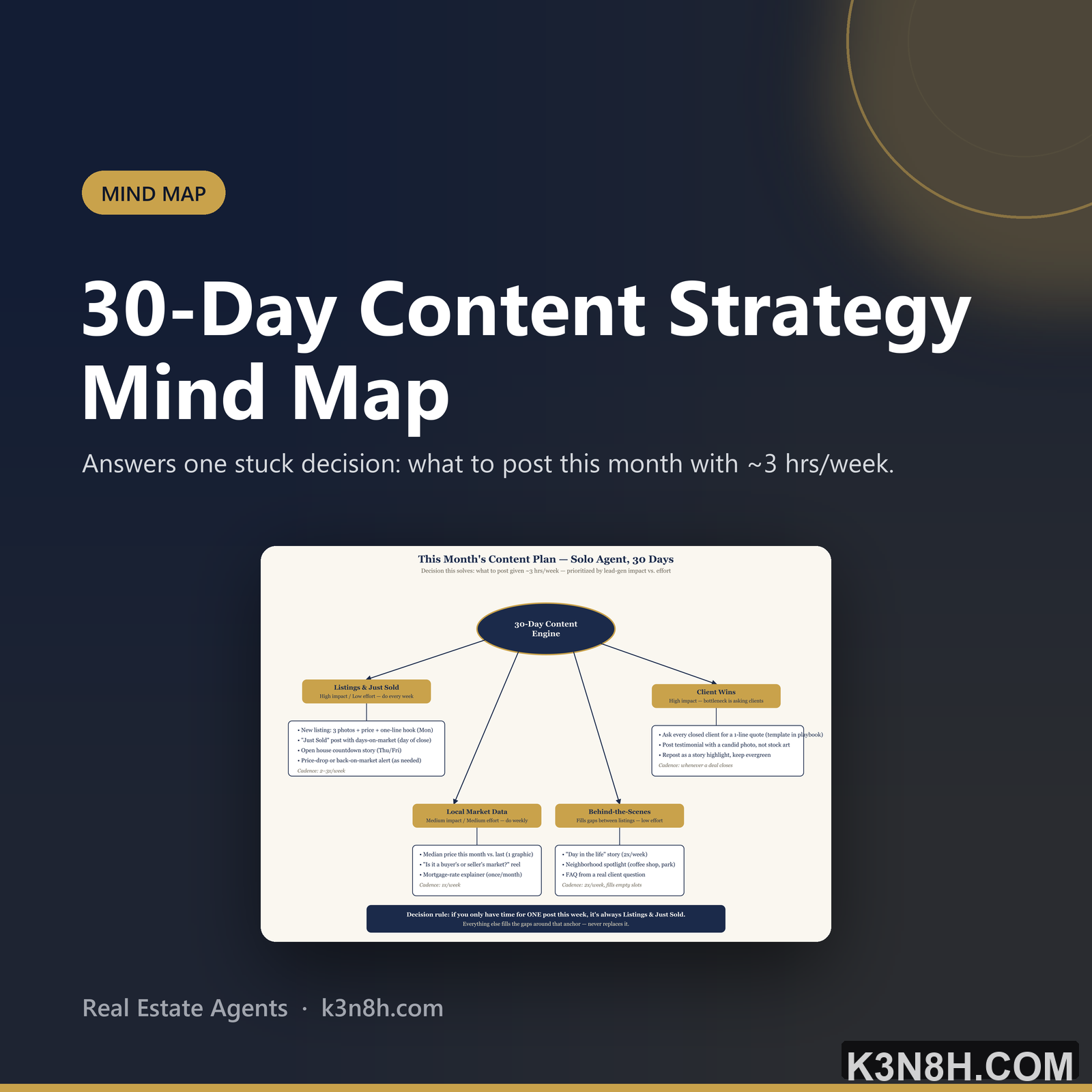
30-Day Content Strategy Mind Map
Answers one stuck decision: what to post this month with ~3 hrs/week.
Listing-to-Close CRM System
Three linked CSV tables — leads, listings, showings — that import straight into Airtable or Sheets.