 K3N8H
Single-Product Launch Plan
Launching a single-product store: summary, market, model, GTM, financials, risks.
K3N8H Verified
- ✓ Real preview shipped
- ✓ License terms specified
- ✓ Stated limitations verified
A niche-specific business plan for launching a single-product dropshipping store, with every financial figure marked as an example assumption to replace with your own supplier and ad costs.
Runs where you work
Built for a private workflow: local-first execution, no forced cloud dependency, and a clear path to use it on a laptop or phone without an API key.
Included value
Each product is designed to feel personal, useful, and complete without turning your work into an external dependency.
Preview
Open full preview →Single-Product Launch Plan
Business Plan: Launching a Single-Product Dropshipping Store
Editable template with a fully filled worked example.
Disclaimer: This document is for informational purposes only and does not constitute financial, legal, or investment advice. All market data, assumptions, and financial projections below are illustrative example figures and must be independently verified against your own supplier costs, ad costs, and market before you rely on them.
1. Executive Summary
[Founder Name] is launching a single-product store selling [Product Name] to [Target Customer], validated through the 7-day launch process (see the companion ebook) before any paid spend. Year 1 target: $8,000/month revenue by month 6 at a 35%+ gross margin after product cost, shipping, and ad spend.
Worked example figures used throughout: $24.99 retail price, $7.50 landed product cost, $4.20 average ad cost per sale, 12% return rate.
2. Market Analysis
- Target market: [describe your specific customer, not "everyone who likes X"].
- Assumption: demand was validated via the soft-launch process (organic/ email traffic converting before any paid spend), not assumed from supplier popularity alone.
- Competitive landscape: [X] comparable listings exist at similar price points. Differentiation here is [specific differentiator — faster real shipping time, a bundle, better honest copy] rather than price alone, since racing to the bottom on price with the same supplier as competitors usually isn't sustainable for a one-person operation.
3. Business Model
- Revenue: single-product direct-to-consumer sales via a dedicated landing page (see the companion Launch Page + Countdown site), not a general storefront in Year 1 — focus compounds faster than breadth for a solo operator.
- Cost structure (example, per unit): product cost $7.50, shipping (absorbed into price) $2.10, platform/payment fees $1.20, average ad cost per sale $4.20 — total cost per sale ~$15.00 against a $24.99 price.
- Unit economics (example): ~$9.99 gross margin per unit before returns; after a 12% return rate (each return costing the full product+shipping cost with no ad recovery), realized margin drops to roughly $7.80/unit.
4. Go-to-Market Plan
| Phase | Timeframe | Focus |
|---|---|---|
| Phase 1 | Week 1 | 7-day validation and soft launch (see companion ebook) before any paid spend |
| Phase 2 | Weeks 2-4 | Small paid-ad tests at a spend level the founder can afford to lose entirely, tracking real ROAS against the break-even number from Section 3 |
| Phase 3 | Months 2-3 | Scale spend in 20-30% steps on winning creative/audience combinations only (see the companion "Which Product to Scale Next" mind map for the same logic applied to multi-product testing) |
| Phase 4 | Months 4-6 | Layer in retention: email flows for repeat purchase, since repeat customers carry no new ad cost |
Assumption: paid ad cost per sale stays roughly stable in the $4-5 range through Month 3 — a real risk if the ad platform's costs shift, covered in Section 6.
5. Financial Projections (Example — Year 1, First 6 Months)
| Month | Units Sold | Revenue (example) | Realized Margin (example) |
|---|---|---|---|
| 1 | 40 | $1,000 | $312 |
| 2 | 90 | $2,249 | $702 |
| 3 | 150 | $3,749 | $1,170 |
| 4 | 220 | $5,498 | $1,716 |
| 5 | 280 | $6,997 | $2,184 |
| 6 | 320 | $7,997 | $2,496 |
Figures assume the ad-cost and return-rate assumptions in Sections 3-4 hold and that scaling steps in Phase 3 succeed. Real results depend heavily on ad platform costs and product-market fit, and can vary significantly from this example.
6. Risks
- Ad cost volatility: paid ad platforms can double cost-per-click with no notice. Mitigation: track cost-per-sale weekly against the Section 3 break-even number; pause spend the moment it's structurally under water, not after a bad week you hope reverses.
- Return rate creep: returns above the modeled 12% erase margin fast. Mitigation: track return reasons — a spike tied to one specific issue (sizing, damage in transit) is fixable; a broad spike across reasons signals a product-market fit problem, not a fixable detail.
- Single-supplier dependency: one supplier issue (stockout, quality drop) stops the whole business. Mitigation: identify a backup supplier before scaling past the validation phase, not after a stockout happens.
- Platform/policy risk: ad account bans or policy changes can cut off the primary acquisition channel overnight. Mitigation: build the email list from day one so at least one channel isn't entirely platform-dependent.
7. How to Use This Template
- Replace the target customer and every example figure with your own real numbers from the validation process.
- Re-run Section 5 with your actual ad cost and return-rate data once you have 30 days of it.
- Revisit Section 6 monthly — a single-product store's risk profile shifts fast in the first two quarters.
Preview truncated — full file included after purchase.
What's included
- business-plan.md (editable)
- README.md
Built with
Written guide in Markdown
License & pricing
Try it before you buy. The preview above is the real product, not a mockup.
Single-Store License
$18
For your own use on a single project. No resale or redistribution.
Multi-Store License
$45
Use across client work or resell the output. No reselling the source files/template itself.
Refund terms are set per product, and checkout through Whop or Gumroad has its own buyer protection. Questions before you buy? Ask in the chat or on the feedback page; we'll help where we can.
Business Plans — publishing standard
- Required deliverables: Editable file, Filled example, Stated assumptions, Risk section, Disclaimer
- Disclaimer required
- Personal vs. commercial license tiers offered
Niche-specific: summary, market, model, go-to-market, financials with stated assumptions, risks.
More from E-commerce / Dropshipping
The 7-Day Product Launch Checklist
Validate and launch a new product before spending on ads — day by day.
Product Description Bot
Product facts in, store-ready listing out — always includes an honest shipping-time line.
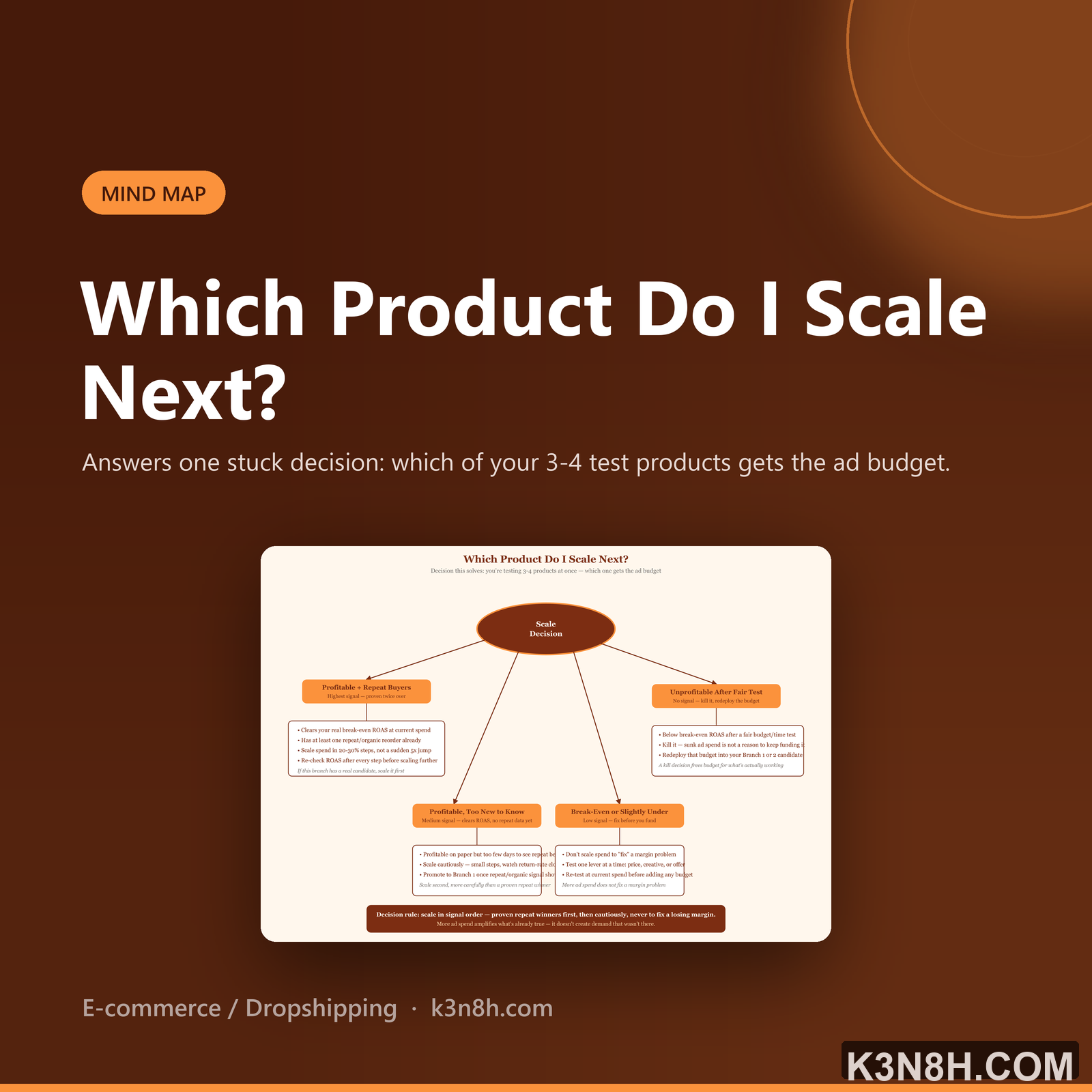
Which Product Do I Scale Next?
Answers one stuck decision: which of your 3-4 test products gets the ad budget.